Wednesday, January 29, 2020

Differentiation Formulas List

Differentiation Formulas List


In all the formulas below, f’ means d(f(x))dx=f(x) and g’ means d(g(x))dx = g(x) . Both f and are the functions of x and differentiated with respect to x. We can also represent dy/dx = Dx y. Some of the general differentiation formulas are;
  1. Power Rule: (d/dx) (xn ) = nxn-1
  2. Derivative of a constant, a:  (d/dx) (a) = 0
  3. Derivative of a constant multiplied with function f: (d/dx) (a. f) = af’
  4.  Sum Rule: (d/dx) (f ± g) = f’ ± g’
  5. Product Rule: (d/dx) (fg)fg’ + gf’ 
  6. Quotient Rule:ddx(fg) = gffgg2

Differentiation Formulas for Trigonometric Functions

Trigonometry is the concept of relation between angles and sides of triangles. Here, we have 6 main ratios, such as, sine, cosine, tangent, cotangent, secant and cosecant. You must have learned about basic trigonometric formulas based on these ratios. Now let us see, the formulas for derivative of trigonometric functions.
  1. ddx(sin x)=cosx
  2. ddx(cos x)=sinx
  3. ddx(tan x)=sec2x
  4. ddx(cot x=csc2x
  5. ddx(sec x)=secxtanx
  6. ddx(csc x)=cscxcotx
  7. ddx(sinh x)=coshx
  8. ddx(cosh x)=sinhx
  9. ddx(tanh x)=sech2x
  10. ddx(coth x)=csch2x
  11. ddx(sech x)=sech2xtanhx
  12. ddx(csch x)=cschx.cothx

Differentiation Formulas for Inverse Trigonometric Functions

Inverse trigonometry functions are the inverse of trigonemetric ratios. Let us see the formulas for derivative of inverse trigonometric functions.
  1. ddx(sin1 x) = 11x2
  2. ddx(cos1 x) = 11x2
  3. ddx(tan1 x) = 11+x2
  4. ddx(cot1 x) = 11+x2
  5. ddx(sec1 x)1|x|x21
  6. ddx(csc1 x)1|x|x21

Laws of Boolean Algebra

Laws of Boolean Algebra


There are six types of Boolean algebra laws. They are:
  • Commutative law
  • Associative law
  • Distributive law
  • AND law
  • OR law
Commutative Law
Any binary operation which satisfies the following expression is referred to as a commutative operation. Commutative law states that changing the sequence of the variables does not have any effect on the output of a logic circuit.
  • A. B = B. A
  • A + B = B + A

Associative Law

It states that the order in which the logic operations are performed is irrelevant as their effect is the same.
  • ( A. B ). C = A . ( B . C )
  • ( A + B ) + C = A + ( B + C)

Distributive Law

Distributive law states the following conditions:
  • A. ( B + C) = (A. B) + (A. C)
  • A + (B. C) = (A + B) . ( A + C)

AND Law

These laws use the AND operation. Therefore they are called AND laws.
  • A .0 = 0
  • A . 1 = A
  • A. A = A
  • A.A¯=0

OR Law

These laws use the OR operation. Therefore they are called OR laws.
  • A  + 0 = A
  • A + 1 = 1
  • A + A = A
  • A+A¯=1


Trigonometry Angles Formula

Trigonometry Angles Formula


Supplementary angles ( = sum is π)
  • Sin ( π – α ) = sin α
  • Cos (π – α ) = – cos α
  • Tan (π – α ) = – tan α
  • Cot (π – α) = – cot α

Anti-supplementary Angles (= difference is π)

  • Sin ( π + α ) = – sin α
  • Cos (π + α ) = – cos α
  • Tan (π + α ) = tan α
  • Cot (π + α ) = cot α

Opposite Angles ( = sum is 2π)

  • Sin ( 2π – α ) = – sin α
  • Cos (2π – α ) = cos α
  • Tan (2π – α ) = -tan α
  • Cot (2π – α ) = – cot α

Complementary Angles (= sum is π/2)

  • Sin ( π/2 – α ) = cos α
  • Cos (π/2 – α ) = sin α
  • Tan (π/2 – α ) = cot α
  • Cot (π/2 – α ) = tan α

Perimeter

Perimeter


Any shape that lies on a flat surface and has only two dimensions i.e. length and breadth are called 2-D (two-dimensional) shape. Every polygon is a 2-D figure which lies flat on a plane. Polygons are closed figures which are bounded by a chain of line segments, for example, triangles, rectangles, and squares. Perimeter (peri: around; meter: measure) of a polygon is the distance or linear measure of these bounded line segments. In other words, it is the length of its boundaries. Its unit is centimetre (cm) or meter (m).
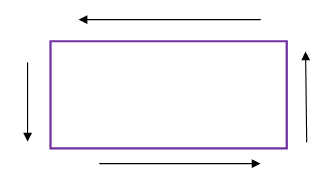
Consider a rectangle, the surrounding distance indicated by the arrows form the perimeter of the given rectangle. It is the sum total covered by two lengths and two breadths.
Formula of Perimeter

Perimeter of Different Shapes – Formulas

We know every shape is different from one another. Thus, the formula for perimeters of geometric shapes also varies from one shape to another. Some common shapes and formula for finding their perimeters are as follows.

Perimeter of Rectangle

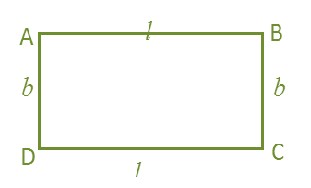
Rectangle is a four-sided polygon having two dimensions i.e. length and breadth.
Formula of Perimeter
Perimeter of a rectangle = sum of four sides
= AB     +     BC        + CD       +   AD
= length + breadth + length + breadth
= 2 length + 2 breadth
Perimeter of a rectangle =   2 × (length + breadth)

Perimeter of Circle

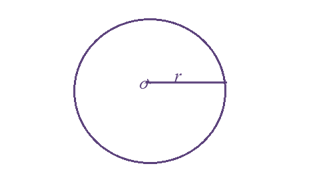
Circle is a collection of points and perimeter of a circle is known as circumference of a circle.
Formula of Perimeter
Circumference of a circle:-
Where r is the radius of the circle and

Perimeter of Square

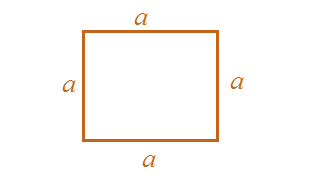
Square is also a polygon where all its sides are the same.
The perimeter of a square = sum of all four sides
= a + a + a+ a
= 4a
Formula of Perimeter
The perimeter of a square = 4 side