Wednesday, January 29, 2020

Analytic Formulas

Analytic Geometry Formulas

Graphs and coordinates are used to find measurements of geometric figures. There are many important formulas in coordinate Geometry. Few of the important ones are being used to find Distance, Slope or to find the equation of the line.

Distance Formula

Let the two points be A and B, having coordinates to be (x1,y1) and (x2,y2) respectively.
Thus, the distance between two points is given as-
d = √[(x2-x1)2+(y2-y1)2]

Midpoint Theorem Formula

Let A and B are some points in a plane, which is joined to form a line, having coordinates (x1,y1) and (x2,y2), respectively. Suppose, M(x,y) is the midpoint of the line connecting the point A and B then its formul is given by;
M(x,y) = [(x1+x2/2),(y1+y2/2)]

Angle Formula

Let two lines have slope m1 and m2 and θ is the angle formed between the two lines A and B, which is represented as;
tan θ = m1-m2/1+m1m2

Section Formula

Let two lines A and B have coordinates (x1,y1) and (x2,y2), respectively. A point P the two lines in the ratio of m:n, then the coordinates of P is given by;
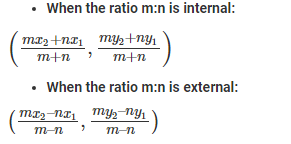
Analytic Geometry-Section Formula


Tuesday, January 28, 2020

Arithmetic Progression

Arithmetic Progression


Arithmetic Progression (AP) is a sequence of numbers in a particular order. If we observe in our regular lives, we come across progression quite often. For example, Roll numbers of a class, days a week or months in a year. Did you notice that counting numbers, even or odd numbers, all follow a particular pattern? This pattern of series and sequences has been generalized in Maths as progressions. Let us learn here AP definition, important terms such as common difference, the first term of the series, nth term and sum of nth term formulas along with solved questions based on them.


Definition

In mathematics, there are three different types of progressions. They are:
  • Arithmetic Progression(AP)
  • Geometric Progression(GP)
  • Harmonic Progression(HP)
A progression is a special type of sequence for which it is possible to obtain a formula for the nth term.  The Arithmetic Progression is the most commonly used sequence in maths with easy to understand formulas.  Let us see its three different types of definition.
Definition 1: It is a mathematical sequence in which the difference between two consecutive terms is always a constant and it is abbreviated as AP.
Definition 2: An arithmetic sequence or progression is defined as a sequence of numbers in which for every pair of consecutive terms, the second number is obtained by adding a fixed number to the first one.
Definition 3: The fixed number that must be added to any term of an AP to get the next term is known as the common difference of the AP.
Now, let us consider the sequence, 1, 4, 7, 10, 13, 16,… is considered as an arithmetic sequence with common difference 3.

General Form of an A. P

Consider an AP to be: a1, a2, a3, ……………., an
Position of TermsRepresentation of TermsValues of Term
1a1a + d = a + (1-1) + d
2a2a + 2d = a + (2-1) + d
3a3a + 3d = a + (3-1) + d
4a4a + 4d = a + (4-1) + d
...
...
...
...
 nana + (n-1)d

Events in Probability

 Events in Probability


The entire possible set of outcomes of a random experiment is the sample space or the individual space of that experiment. The likelihood of occurrence of an event is known as probability. The probability of occurrence of any event lies between 0 and 1.

Impossible and Sure Events

If the probability of occurrence of an event is 0, such an event is called an impossible event and if the probability of occurrence of an event is 1, it is called a sure event. In other words, the empty set ϕ is an impossible event and the sample space S is a sure event.

Simple Events

Any event consisting of a single point of the sample space is known as a simple event in probability. For example, if S = {56 , 78 , 96 , 54 , 89} and E = {78} then E is a simple event.

Compound Events

Contrary to the simple event, if any event consists of more than one single point of the sample space then such an event is called a compound event. Considering the same example again, if S = {56 ,78 ,96 ,54 ,89}, E1 = {56 ,54 }, E2 = {78 ,56 ,89 } then, E1 and E2 represent two compound events.

Independent Events and Dependent Events

If the occurrence of any event is completely unaffected by the occurrence of any other event, such events are known as an independent event in probability and the events which are affected by other events are known as dependent events.

Mutually Exclusive Events

If the occurrence of one event excludes the occurrence of another event, such events are mutually exclusive events i.e. two events don’t have any common point. For example, if S = {1 , 2 , 3 , 4 , 5 , 6} and E1, E2 are two events such that E1 consists of numbers less than 3 and E2 consists of numbers greater than 4.
So, E1 = {1,2} and E2 = {5,6} .
Then, E1 and E2 are mutually exclusive.

Exhaustive Events

A set of events is called exhaustive if all the events together consume the entire sample space.

Complementary Events

For any event E1 there exists another event E1‘ which represents the remaining elements of the sample space S.
E1 = S − E1
If a dice is rolled then the sample space S is given as S = {1 , 2 , 3 , 4 , 5 , 6 }. If event E1 represents all the outcomes which is greater than 4, then E1 = {5,6} and E1‘ = {1,2,3,4}.
Thus E1‘ is the complement of the event E1.
Similarly, the complement of E1, E2, E3……….Ewill be represented as E1‘, E2‘, E3‘……….En

Cube

 Cube

DEFINITION:
A cube is a three-dimensional shape which is defined XYZ plane. It has six faces, eight vertices and twelve edges. All the faces of the cube are in square shape and have equal dimensions

Properties of Cube

  • A cube has three faces and three edges of equal length.
  • It has square-shaped faces.
  • The angles of the cube in the plane are at a right angle.
  • Each face of the cube meets four other faces.
  • Each vertex of the cube meets three faces and three edges.
  • Opposite edges of the cube are parallel to each other.

Cube Formula:

Surface Area of a Cube:
For cube, length = breadth = height
Suppose length of an edge =l
Hence, surface area of the cube = 2(l × l +l × l + l × l) = 2 x 3l = 6l2
Total Surface Area of Cube= 6l2
Lateral surface area of a Cube:
Formula to find Lateral surface area of the cube is:
2(l × l + l × l) = 4l2
LSA of Cube = 4l2


Real Functions

Functions and Relations


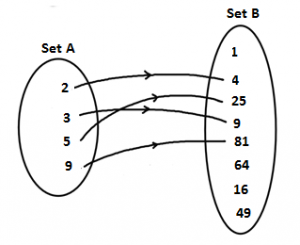
A relation is a rule that “relates” an element from one set to an element from another set. A function is a special kind of relation. A relation F is said to be a function if each element in set A is associated with exactly one element in set B., For example, a relation F from set A to set B such that it associates a natural number to its square is a function because for every element in set A, we will have exactly one association in set B.
Real Functions

Operations on Real Functions

Now that we understand what functions are let us discuss how we perform mathematical operations on real functions such as the addition of two or more functions, subtraction of two functions, multiplying a real function by a real number etc.

Adding Two Real Functions

For adding two real functions let us define the functions f and g such that f: X ⟶R and g: X ⟶are two real functions such that X is a subset of R. Then (f + g): X ⟶can be defined as:
 (f + g)(x)=f(x) + g(x), for all x ϵ X

Subtracting Two Functions

For subtracting two real functions let us define the functions f and g such that f: X ⟶R and g: X ⟶are two real functions such that X is a subset of R. Then (f – g): X ⟶R can be defined as:
 (f – g)(x)=f(x) – g(x), for all x ϵ X

Multiplying a Real Function by a Scalar (Real Number)

Let us define a real function f such that f: X ⟶R, X⊆R and a ϒ be a real scalar quantity. Then the product of scalar ϒ and the function f is also a function defined from X to as:
 (ϒf)(x) = ϒf(x), for all x ϵ X

Multiplying Two Functions

For multiplying two real functions let us define the functions f and g such that f: X ⟶R and g: X ⟶are two real functions such that X is a subset of R. Then fg: X ⟶R can be defined as:
(fg)(x) = f(x)g(x), for all x ϵ X

Quotient of Two Functions

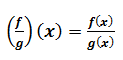
For determining the quotient of two real functions let us define the functions f and g such that f: X ⟶R and g: X ⟶are two real functions such that X is a subset of R. Then f/g: X ⟶R can be defined as:Real FunctionsGiven that g (x) ≠ 0, for all x ɛ X


Pascal's Triangle

Pascal’s Triangle Patterns


1) Addition of the Rows: One of the interesting properties of the triangle is that
the sum of its rows is equal to 2n
where n corresponds to the number of the row:
1 = 1 = 20
1 + 1 = 2 = 21
1 + 2 + 1 = 4 = 22
1 + 3 + 3 + 1 = 8 = 23
1 + 4 + 6 + 4 + 1 = 16 = 24
2) Prime Numbers in the Triangle: Another pattern visible in the triangle deals with prime numbers. If a row starts with a prime number or is a prime numbered row, all the numbers that are in that row (not counting the 1’s) are divisible by that prime. If we look at row 5 (1 5 10 10 51), we can see that 5 and 10 are divisible by 5. However, for a composite numbered row, such as row 8 (1 8 28 56 70 56 28 8 1), 28 and 70 are not divisible by 8.
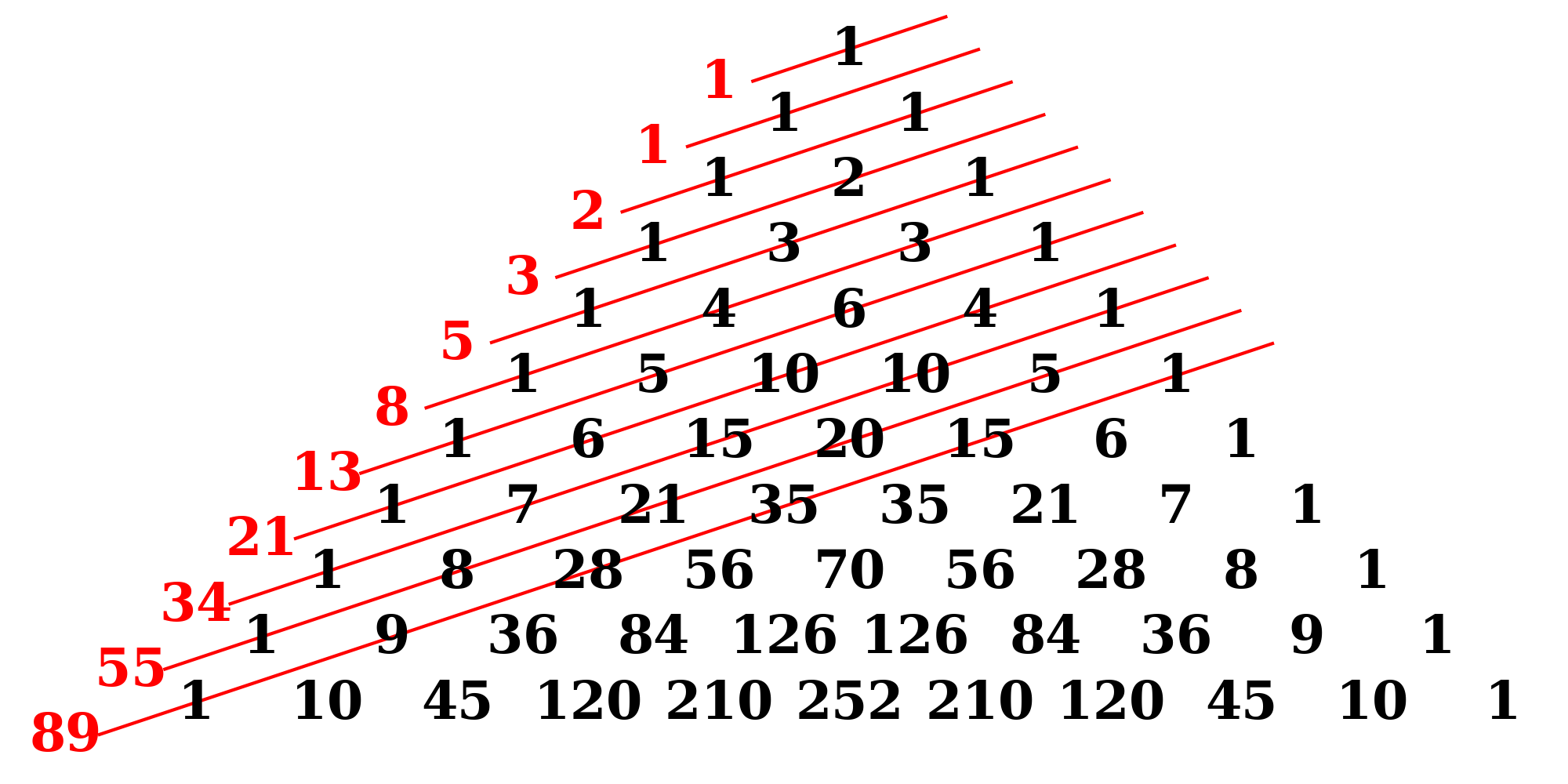
3) Fibonacci Sequence in the Triangle: By adding the numbers in the diagonals of the Pascal triangle the Fibonacci sequence can be obtained as seen in the figure given below.
Pascal's Number Application- Fibonacci series
There are various ways to show the Fibonacci numbers on the Pascal triangle. R. Knott was able to find the Fibonacci appearing as sums of “rows” in the Pascal triangle. He moved all the rows over by one place and here the sums of the columns would represent the Fibonacci numbers.

Properties of Pascal’s Triangle

    • Each number is the sum of the two numbers above it.
    • The outside numbers are all 1.
    • The triangle is symmetric.
    • The first diagonal shows the counting numbers.
    • The sums of the rows give the powers of 2.
    • Each row gives the digits of the powers of 11.
    • Each entry is an appropriate “choose number.”
    • And those are the “binomial coefficients.”

Probability Formula

Formula to Calculate Probability


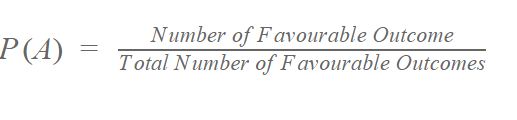
The formula of the probability of an event is:
Probability of an Event Formula
Probability Formula
Or,
P(A) = n(E)/n(S)
Where,
  • P(A) is the probability of an event “A”
  • n(E) is the number of favourable outcomes
  • n(S) is the total number of events in the sample space

Basic Probability Formulas

Let A and B are two events. The probability formulas are listed below:
All Probability Formulas List in Maths
Probability Range0 ≤ P(A) ≤ 1
Rule of AdditionP(A∪B) = P(A) + P(B) – P(A∩B)
Rule of Complementary EventsP(A’) + P(A) = 1
Disjoint EventsP(A∩B) = 0
Independent EventsP(A∩B) = P(A) ⋅ P(B)
Conditional ProbabilityP(A | B) = P(A∩B) / P(B)
Bayes FormulaP(A | B) = P(B | A) ⋅ P(A) / P(B)